


When you come in for Pelvic Floor Physio treatment, one of the foundational training techniques your therapists will do with you is breath work.
A lot of patients’ response to this is “I don’t get how breathing relates to bladder leakage, straining, low back pain etc.”
From an outside perspective, breathing and pelvic floor functioning do not seem related. However, it we strip back the layers and uncover the human anatomy, you will see that the two are VERY connected.
Let’s take a look.
Your Breath and Your Biology
Your torso is supported by your core muscles. Your core muscles are composed of the diaphragm muscle at the top, the abdominal muscles at the front/sides, the spinal column/back muscles at the back and the pelvic floor muscles at the bottom. These 4 groups of muscles – cumulatively called your core muscles, are connected forming a cylinder from your upper ribs down to your pelvic floor.
This connection is KEY.
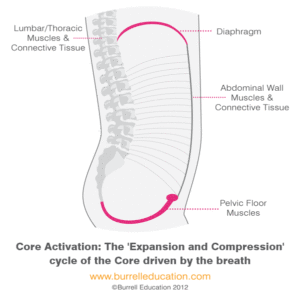
When you breathe in, your ribs expand, your diaphragm flattens and lowers and your organs drop. Your pelvic floor and abdominal muscles then lengthen and expand to make room for your organs.
When you exhale, the opposite happens. Your diaphragm lifts and your pelvic floor and abdominal muscles contract and shorten to return to their resting position.
Each part of this system is designed to work in tandem together. If one part of your body isn’t functioning correctly because of pain, weakness, tightness, scar tissue, stress, posture, poor breathing patterns etc. pelvic floor dysfunction can occur.
How to breathe for your pelvic floor
So we now understand why the breath is a keystone element in pelvic floor therapy. But how does one ‘breathe correctly?’
Check out these top tips to help improve your breathing pattern.
1. Bring awareness to your breath.
The first step to solving an issue is to become aware of it in the first place. You might discover that you hold your breath when you’re stressed, breath shallow when you’re focussed, or strain your breath when your exerting yourself. Once you understand you patterns, you can start to address forming new behaviours.
2. Keep breathing.
You’d be surprised at how often we all hold our breath in a day. This is a common behaviour when we feel stressed, anxious, excited, upset or frustrated. But holding our breath means less oxygen, more carbon dioxide and your diaphragm is not expanding and contracting to its full capacity.
3. In through the nose. Out through the nose.
Inhale and exhale through your nose. Why? Your nose refines air quality and slows down your breathe in comparison to mouth breathing. Breathing through your nose also allows you to relax your tongue by letting it sit on the roof of your mouth. This in turn relaxes your jaw muscles which can reduce tension headaches.
There are many other techniques and tips we would implement in a pelvic floor physio care plan.
If you’re experiencing pelvic floor dysfunction, call us today for a free consultation.
We can help you overcome it.